Namespacing tokens prevents collisions with external systems
- Published • 5 min
Introduction
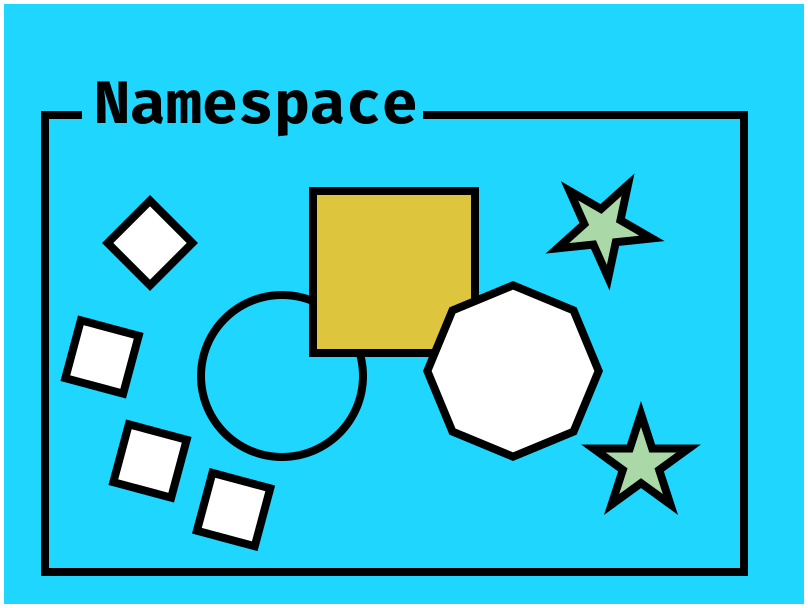
Tokens or generally CSS variables from external systems can silently override your app tokens. Here’s’ the short story of how to keep your tokens safe.
Astro is a great blog engine which enables you to use Vue.js or React components seamlessly. I’ve built a React component and wanted to use Tailwind for it. It turned out that my --color-red-300 has been replaced with the value from Tailwind --color-red-300.
// Shortened for simplicity
---
import AComponent from "@components/AComponent/AComponent";
---

<div class="flex flex-col">
    <AComponent client:load />
</div><AComponent /> is importing Tailwind stylesheets:
/* src/components/AComponent/AComponent.css */
@import "tailwindcss/theme.css";
@import "tailwindcss/utilities.css";
It was barely noticeable, but a single @import "tailwindcss/theme.css"; did that:
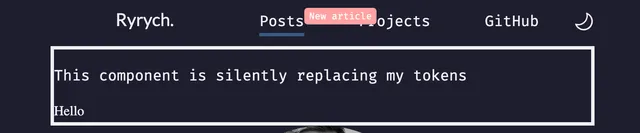
It happened because Tailwind theme.css defines
--color-red-300: oklch(80.8% 0.114 19.571) whereas app token was: --color-pomegranate-300: oklch(0.56 0.19 25.68);
/* packages/tailwindcss/theme.css */

:root {
  --color-red-50: oklch(97.1% 0.013 17.38);
  --color-red-100: oklch(93.6% 0.032 17.717);
  --color-red-200: oklch(88.5% 0.062 18.334);
  --color-red-300: oklch(80.8% 0.114 19.571);
  --color-red-400: oklch(70.4% 0.191 22.216);
  --color-red-500: oklch(63.7% 0.237 25.331);
  --color-red-600: oklch(57.7% 0.245 27.325);
  --color-red-700: oklch(50.5% 0.213 27.518);
  --color-red-800: oklch(44.4% 0.177 26.899);
  --color-red-900: oklch(39.6% 0.141 25.723);
  --color-red-950: oklch(25.8% 0.092 26.042);
}
As it silently replaces values, it could theoretically replace more without me noticing.
Namespace-first attempt
It just failed.
I asked Claude. I wanted to add just a prefix, but the way Claude conducted that disappointed me as it was trying to inject into the Astro hook and via PostCSS replace app tokens by adding --ryrych- prefix. As it took forever I quit.
Follow your intuition or experience first, instead of lazily following hallucinations. Yeah, facepalm, it happens to me sometimes.
Namespace-second attempt
Having a sub-package is a good idea. Until you need to publish it, just have it locally. And this is what I wanted. Sorry Claude for suggesting, I knew it better. Just do it.
src/packages/design-tokens/build.mjs was a good approach. Just moving all variables defined in :root {…} into a package:
import fs from "node:fs";
import path from "node:path";
import { fileURLToPath } from "node:url";
import postcss from "postcss";

const packageDir = path.dirname(fileURLToPath(import.meta.url));
const srcDir = path.join(packageDir, "src");
const outFile = path.join(packageDir, "dist", "index.css");
const prefix = process.env.TOKENS_PREFIX || "ryrych";

function prefixDecl(decl) {
  decl.prop = `--${prefix}-${decl.prop.slice(2)}`;
  decl.value = decl.value.replaceAll("var(--", `var(--${prefix}-`);
}

const sourceFiles = fs
  .readdirSync(srcDir)
  .filter((file) => file.endsWith(".css"))
  .sort();

const built = sourceFiles
  .map((file) => {
    const sourcePath = path.join(srcDir, file);
    const root = postcss.parse(fs.readFileSync(sourcePath, "utf8"), {
      from: sourcePath,
    });
    root.walkRules(":root", (rule) => rule.walkDecls(/^--/, prefixDecl));
    return `/* ${file} */\n${root.toString().trim()}`;
  })
  .join("\n\n");

fs.mkdirSync(path.dirname(outFile), { recursive: true });
fs.writeFileSync(
  outFile,
  `/**\n * AUTO-GENERATED by \`npm run build\` — do not edit directly.\n * Edit the source files in ./src instead.\n */\n\n${built}\n`,
);

console.log(
  `built ${path.relative(process.cwd(), outFile)} (prefix: ${prefix})`,
);
It worked.
Namespace-third attempt
It kind of made me dissatisfied. I was writing about Style Dictionary (in Polish) and wanted to use it. It is opinionated stuff and the migration went smoothly:
import path from "node:path";
import { fileURLToPath } from "node:url";
import StyleDictionary from "style-dictionary";

const packageDir = path.dirname(fileURLToPath(import.meta.url));
const buildPath = `${path.join(packageDir, "dist")}/`; // must end with a trailing slash
const prefix = process.env.TOKENS_PREFIX || "ryrych";

const sd = new StyleDictionary({
  source: [
    path.join(packageDir, "tokens/colors.json"),
    path.join(packageDir, "tokens/theme.json"),
    path.join(packageDir, "tokens/typography.json"),
  ],
  log: { verbosity: "silent" },
  platforms: {
    css: {
      transformGroup: "css",
      prefix,
      buildPath,
      files: [
        {
          destination: "index.css",
          format: "css/variables",
          options: {
            outputReferences: true,
            fileHeader: () => [
              "AUTO-GENERATED by `npm run build` — do not edit directly.",
              "Edit the source files in ./tokens instead.",
            ],
          },
        },
      ],
    },
  },
});

await sd.buildAllPlatforms();

const outFile = path.join(buildPath, "index.css");
console.log(
  `built ${path.relative(process.cwd(), outFile)} (prefix: ${prefix})`,
);
I used workspaces:
{
  "workspaces": ["packages/*"]
}
Tokens are build with npm run build:tokens
{
  "scripts": {
    "build:tokens": "npm run build --prefix packages/design-tokens"
  }
}
Tokens defined this way:
// packages/design-tokens/tokens/colors.json
{
  "color": {
    "pomegranate": {
      "100": { "value": "oklch(0.85 0.19 25.68)" },
      "200": { "value": "oklch(0.7 0.19 25.68)" },
      "300": { "value": "oklch(0.56 0.19 25.68)" },
      "400": { "value": "oklch(0.37 0.19 25.68)" },
      "500": { "value": "oklch(0.19 0.19 25.68)" }
    },
    "lime": {
      "100": { "value": "oklch(0.92 0.26 142.5)" },
      "200": { "value": "oklch(0.84 0.26 142.5)" },
      "300": { "value": "oklch(0.76 0.26 142.5)" },
      "400": { "value": "oklch(0.5 0.26 142.5)" },
      "500": { "value": "oklch(0.25 0.26 142.5)" }
    },
    "black": { "value": "#000000" },
    "white": { "value": "#ffffff" },
    "accent": { "value": "#c2feff" },
    "red": {
      "100": { "value": "{color.pomegranate.100}" },
      "200": { "value": "{color.pomegranate.200}" },
      "300": { "value": "{color.pomegranate.300}" },
      "400": { "value": "{color.pomegranate.400}" },
      "500": { "value": "{color.pomegranate.500}" }
    }
  }
}
Lands in dist/index.css exactly the same way until I had problems with Tailwind.
/* packages/design-tokens/dist/index.css */
:root {
  --ryrych-color-pomegranate-100: oklch(0.85 0.19 25.68);
  --ryrych-color-pomegranate-200: oklch(0.7 0.19 25.68);
  --ryrych-color-pomegranate-300: oklch(0.56 0.19 25.68);
  --ryrych-color-pomegranate-400: oklch(0.37 0.19 25.68);
  --ryrych-color-pomegranate-500: oklch(0.19 0.19 25.68);
  --ryrych-color-lime-100: oklch(0.92 0.26 142.5);
  --ryrych-color-lime-200: oklch(0.84 0.26 142.5);
  --ryrych-color-lime-300: oklch(0.76 0.26 142.5);
  --ryrych-color-lime-400: oklch(0.5 0.26 142.5);
  --ryrych-color-lime-500: oklch(0.25 0.26 142.5);
  --ryrych-color-black: #000000;
  --ryrych-color-white: #ffffff;
  --ryrych-color-accent: #c2feff;
  --ryrych-background: #1e1e2e;
  --ryrych-background-light: #fcebf3;
  --ryrych-text: #eff1f5;
  --ryrych-text-light: #1e1e2e;
  --ryrych-text-link: #78c2ad;
  --ryrych-text-link-light: #375a7f;
  --ryrych-underline: #375a7f;
  --ryrych-border-radius-full: calc(infinity * 1px);
  --ryrych-header: "Lato", sans-serif;
  --ryrych-body: "Fira Code", monospace;
  --ryrych-color-red-100: var(--ryrych-color-pomegranate-100);
  --ryrych-color-red-200: var(--ryrych-color-pomegranate-200);
  --ryrych-color-red-300: var(--ryrych-color-pomegranate-300);
  --ryrych-color-red-400: var(--ryrych-color-pomegranate-400);
  --ryrych-color-red-500: var(--ryrych-color-pomegranate-500);
}
Summary
I like to have control over naming conventions. When you are integrating external packages like Tailwind you never know what external code might silently break. Adding a namespace to your tokens can minimize problems. A few weeks ago a GitHub. workflow responsible for screenshot testing was hanging. It was a GitHub. issue, effectively preventing me from creating a new releases. I temporarily removed it. I think it’s time to bring screenshot testing with Playwright back. My eyes might not be enough to spot silent bugs.